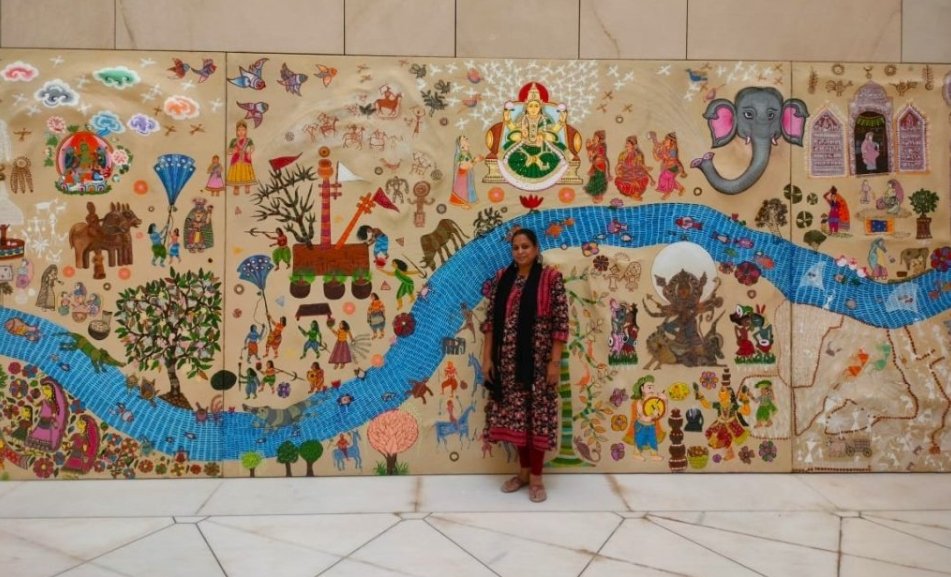
For some artists, landscape is primarily a subject to be painted. For Satyabhama Majhi, landscape can also become a source of cultural understanding, artistic material and social reflection. Her long-term engagement with the Niyamgiri region and the Dongaria Kondh community has become an important dimension of her contemporary art practice.
Based in Bhubaneswar, Odisha, Majhi works across painting, sculpture, installation, photography, mixed media, public art and community-based art. Her engagement with Niyamgiri has contributed particularly to her exploration of indigenous knowledge, ecology, natural materials, cultural identity and the relationship between communities and their environments.
Rather than treating the region simply as an exotic visual subject, her practice has developed through sustained observation and interaction with the community and its surroundings.
A Long-Term Artistic Engagement
Majhi’s relationship with the Dongaria Kondh community has extended for more than a decade.
Long-term engagement can create a different kind of artistic understanding from a brief visit.
It allows an artist to observe changes, learn about everyday practices and develop a deeper appreciation of the relationships connecting people with their environment.
For Majhi, this engagement has included attention to cultural practices, livelihood patterns, indigenous visual traditions and the natural environment of Niyamgiri.
These experiences have informed both the subjects and materials of her work.
Niyamgiri Beyond the Landscape
The Niyamgiri hills occupy an important place in Majhi’s artistic thinking.
The region is not simply a geographical setting. It is connected with the cultural identity, livelihood, spirituality and everyday experiences of the people living there.
This relationship between community and landscape has encouraged Majhi to look at the environment through a cultural as well as visual perspective.
A mountain can be a physical form.
But it can also represent memory, identity, sacred geography and belonging.
This layered understanding of landscape is central to the way Niyamgiri enters her artistic vocabulary.
Learning Through Observation
Majhi’s community practice places considerable importance on observation.
Instead of beginning with preconceived ideas about a community, the artist’s approach involves observing existing practices and listening to experiences.
This becomes particularly important when working with indigenous communities whose cultural knowledge may be closely connected with particular landscapes.
Through sustained engagement, visual elements can be understood within their broader cultural context.
For Majhi, this has contributed to an artistic practice that combines contemporary experimentation with knowledge gained from community interaction.
Indigenous Knowledge as Living Knowledge
Traditional and indigenous knowledge is sometimes presented as something belonging entirely to the past.
Majhi’s work offers a different perspective.
Her engagement with the Dongaria Kondh community demonstrates how cultural knowledge can remain connected with everyday life.
Knowledge can be expressed through relationships with land, livelihood, food, colour, architecture, ritual, seasonal activities and visual traditions.
These forms of knowledge do not necessarily exist as written texts.
They can be transmitted through practice and experience.
This makes community engagement an important part of understanding them.
The Connection Between People and Nature
One of the recurring concerns in Majhi’s work is the relationship between people and their environment.
Niyamgiri provides a particularly strong context for exploring this relationship.
The natural environment is connected with livelihood and cultural practices.
The landscape also influences artistic imagination.
This relationship challenges the idea that nature and society are separate subjects.
For communities whose lives are closely connected with particular landscapes, environmental change can also become cultural change.
Majhi’s artistic practice explores this connection.
Natural Pigments from the Landscape
One of the most distinctive aspects of Majhi’s Niyamgiri-related practice is her experimentation with naturally sourced materials.
Her exploration includes materials such as chalk stone, charcoal, turmeric, geru soil and brown stone.
These materials can be processed into pigments and used in artistic work with appropriate binders.
The significance of this process goes beyond colour.
The materials establish a physical connection between artwork and environment.
A pigment derived from the landscape carries a different relationship to place than an entirely manufactured colour.
Colour as Cultural Connection
Colour is often discussed in terms of visual aesthetics.
But natural pigments can also raise questions about geography and cultural practice.
Turmeric, soil, stone and charcoal are everyday materials that can exist within local environments and cultural practices.
When such materials enter an artwork, they connect artistic production with the physical world.
Majhi’s experimentation therefore provides a meeting point between traditional material knowledge and contemporary artistic practice.
The Triangle and the Mountains
The triangle has become another important visual element in works influenced by Majhi’s engagement with Dongaria Kondh visual culture.
The form can evoke the silhouette of the Niyamgiri hills.
At the same time, it introduces a strong geometric structure into her compositions.
The triangle has been associated in her artistic exploration with ideas of landscape, stability, sacred geography and divinity.
It can therefore function simultaneously as a visual shape and a cultural reference.
Combining Geometry with Everyday Life
Majhi does not necessarily isolate the triangle as a standalone symbol.
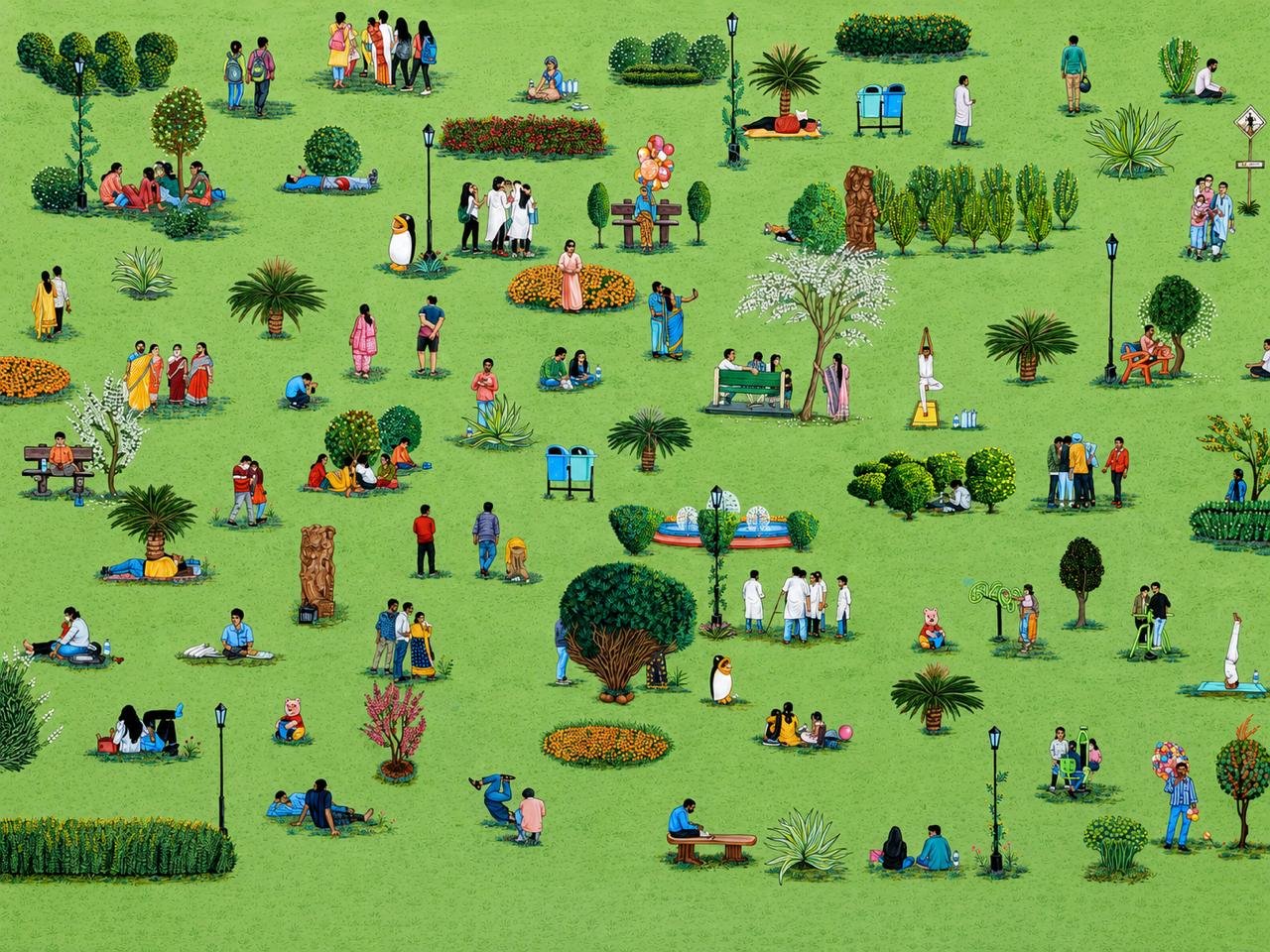
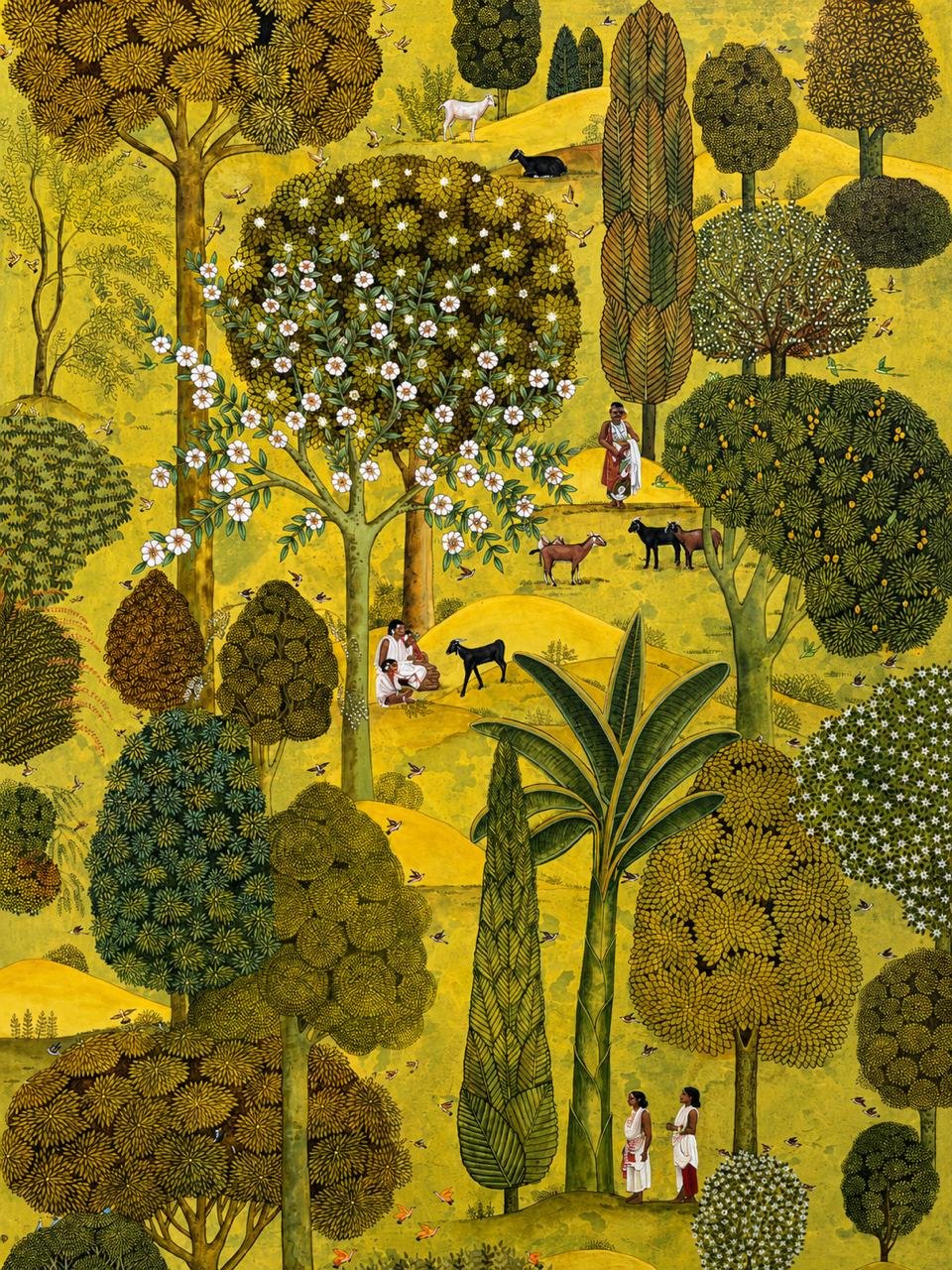
It can appear alongside people, animals, vegetation and scenes of everyday life.
This combination creates a layered visual language.
The mountain-inspired form can provide the structural foundation, while figures and natural elements introduce movement and activity.
The resulting composition connects landscape with community.
The environment becomes part of the story rather than a distant background.
The Idea of “Up and Down”
The Niyamgiri experience also influenced Majhi’s conceptual work “Up and Down.”
The title refers to the physical movement involved in travelling uphill and downhill in the hilly region.
For people living and working within such a landscape, movement through slopes can be part of everyday life.
Majhi transformed this observation into a broader reflection on human existence.
Life itself involves continuous movement.
People move between circumstances, challenges and opportunities.
The physical experience of moving up and down therefore becomes a metaphor for the changing conditions of human life.
Geography and Human Experience
“Up and Down” also demonstrates how geographical observation can become conceptual art.
The artist begins with something physically experienced.
The hills.
The movement.
The daily journey.
The effort involved in navigating the landscape.
From these observations emerges a broader reflection.
The artwork therefore does not simply illustrate Niyamgiri.
It uses the experience of Niyamgiri to think about universal human experiences.
Avoiding a Distant View of Community
Majhi’s long-term engagement is important because it allows her work to move beyond a superficial representation of indigenous life.
The Dongaria Kondh community is not treated merely as a source of picturesque imagery.
Instead, attention is given to cultural practices, livelihood, visual traditions and relationships with nature.
This distinction is important in contemporary socially engaged art.
Communities can be participants in artistic understanding rather than passive subjects.
Cultural Memory and Visual Traditions
Indigenous visual traditions can preserve information about a community’s relationship with place.
Patterns, symbols, colours and forms may carry cultural associations.
Majhi’s interest in these traditions has contributed to her broader exploration of cultural memory.
Her work asks how visual knowledge can move into contemporary art without losing its relationship to the culture from which it emerged.
This creates a dialogue between preservation and reinterpretation.
Traditional Knowledge Meets Contemporary Art
Majhi’s academic background in Traditional Art provides an important foundation for this dialogue.
Her M.F.A. in Traditional Art gave her formal exposure to traditional artistic practices.
Her later work demonstrates how this knowledge can be expanded through contemporary experimentation.
Natural pigments can become part of contemporary mixed-media work.
Indigenous visual references can influence modern compositions.
Community experience can become a source for conceptual art.
Traditional knowledge therefore becomes a starting point rather than a limitation.
Ecology and Artistic Practice
The Niyamgiri-related work also connects Majhi’s artistic practice with ecological thinking.
The environment is not simply something represented visually.
It influences material, culture, livelihood and identity.
This perspective allows ecological questions to be considered alongside social and cultural questions.
When a landscape changes, the consequences can extend beyond scenery.
Changes can affect how people live, work, remember and understand their surroundings.
Art can provide a space for considering these connections.
Community, Livelihood and Identity
Majhi’s engagement with the Dongaria Kondh community has also involved attention to livelihood patterns.
Livelihood is closely related to environment.
The resources available in a landscape influence everyday practices, while cultural traditions influence how communities understand and use those resources.
This relationship creates a complex network connecting economy, ecology and identity.
Majhi’s work draws attention to these connections without reducing them to a single message.
A Different Way of Seeing Landscape
Traditional landscape painting often asks the viewer to admire the visual beauty of a place.
Majhi’s approach encourages a more layered understanding.
A landscape can contain cultural memory.
It can shape community identity.
It can influence artistic materials.
It can carry spiritual meaning.
It can determine aspects of livelihood.
And it can become part of contemporary artistic reflection.
Niyamgiri therefore becomes both a landscape and a cultural context.
From Niyamgiri to the Wider Art World
Although Majhi’s engagement with Niyamgiri is rooted in a specific region, the questions emerging from it have wider relevance.
Across India and around the world, communities are negotiating relationships between traditional knowledge, environmental change and modern development.
Artists can contribute to these conversations by creating visual spaces for reflection.
Majhi’s work brings a regional experience into the wider field of contemporary Indian art.
Material, Memory and Place
The relationship between natural pigments and Niyamgiri illustrates a broader principle within Majhi’s practice: materials can carry memories of place.
When soil, stone or plant-derived colour becomes part of an artwork, the physical material can reinforce the conceptual relationship between the artwork and the landscape.
This makes material choice an expressive decision.
It connects technique with geography.
A Practice Based on Relationships
The Niyamgiri dimension of Majhi’s career can ultimately be understood through relationships.
People and landscape.
Culture and environment.
Tradition and contemporary art.
Material and memory.
Community and artist.
Observation and interpretation.
These relationships provide a foundation for understanding why Niyamgiri has become such an important influence within her artistic vocabulary.
Conclusion
Satyabhama Majhi’s engagement with Niyamgiri and the Dongaria Kondh community represents one of the most distinctive aspects of her artistic practice.
Through more than a decade of engagement, she has explored indigenous visual traditions, livelihood patterns, cultural practices, natural materials and the relationship between communities and their environment.
These experiences have influenced her use of natural pigments, mountain-inspired geometric forms and conceptual ideas such as “Up and Down.”
What makes this work significant is the way it brings local knowledge into contemporary artistic enquiry.
Niyamgiri is not presented merely as a scenic landscape. It becomes a place through which questions of identity, ecology, memory, spirituality and human experience can be explored.
Majhi’s practice demonstrates that contemporary art can learn from traditional and indigenous knowledge while creating new forms of expression.
Her work ultimately presents landscape not simply as something to look at, but as something to listen to, learn from and understand through the people whose lives are connected to it.