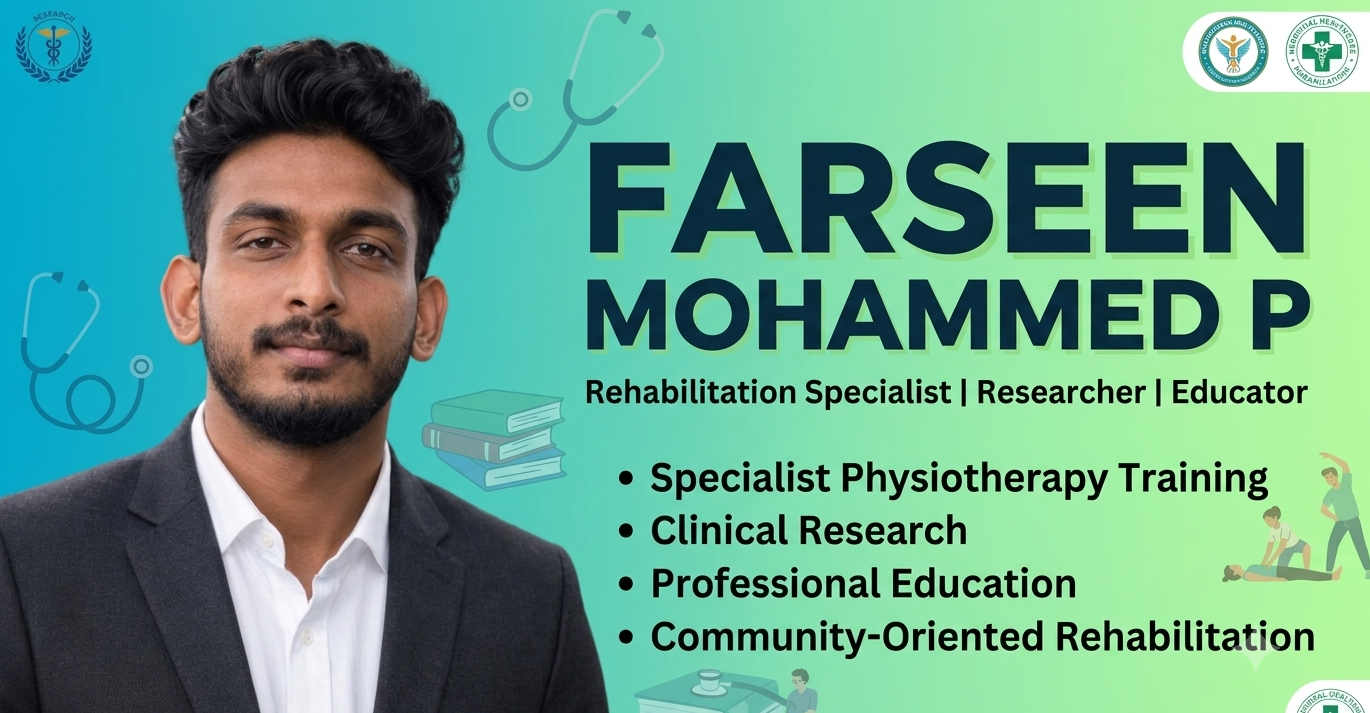
Mangaluru, Karnataka: Neurological rehabilitation is closely connected with the goal of helping individuals improve movement, mobility and participation in everyday activities. For Farseen Mohammed P, a specialist physiotherapist in neurosciences and clinical researcher, functional recovery has become an important theme within his clinical education, rehabilitation training and research interests.
With postgraduate specialization in neurophysiotherapy and neurorehabilitation, Farseen has developed experience across neurological conditions while also exploring rehabilitation interventions through clinical research and evidence synthesis.
Understanding Functional Recovery
Neurological disorders can affect a person’s ability to move, walk, maintain balance, perform daily activities and participate independently in the community.
Physiotherapy can form an important part of rehabilitation by addressing movement-related limitations and supporting patients as they work toward functional goals.
Farseen’s professional training has focused on understanding these challenges through both clinical practice and academic study.
Specialized Education in Neurophysiotherapy
Farseen completed his Master of Physiotherapy in Neurosciences at Yenepoya Physiotherapy College, Yenepoya (Deemed to be University), Mangaluru.
His postgraduate specialization focused on neurophysiotherapy and neurorehabilitation.
The programme provided advanced academic knowledge and clinical exposure related to neurological rehabilitation.
This specialization has become the foundation of his professional interest in functional recovery and evidence-based rehabilitation.
Clinical Exposure to Neurological Conditions
During postgraduate clinical training at Yenepoya Medical College Hospital, Mangaluru, Farseen gained exposure to a range of neurological conditions.
His clinical experience included rehabilitation involving:
- Stroke
- Parkinson’s disease
- Traumatic brain injury
- Guillain–Barré syndrome
- Spinal cord disorders
Working with different neurological conditions provided exposure to varied functional limitations and rehabilitation requirements.
Functional Mobility After Stroke
Stroke rehabilitation is one of the strongest themes in Farseen’s academic work.
His postgraduate dissertation examined the:
“Effect of Eccentric Versus Concentric Strengthening on Functional Mobility in Subacute Stroke Patients: A Randomized Parallel-Group Comparative Study.”
The study focused on strengthening interventions and functional mobility in people recovering from subacute stroke.
The research demonstrates his interest in examining rehabilitation interventions through measurable functional outcomes.
Research Into Strengthening Interventions
Farseen’s interest in functional recovery has continued through evidence-synthesis research.
He has worked on a systematic review examining the effectiveness of eccentric strengthening interventions on functional outcomes in adults after stroke.
This work builds upon his postgraduate research while considering evidence from a broader body of literature.
His presentation of related research at SYNERGOS 2026 received the First Prize in the Postgraduate Category for Oral Paper Presentation.
Motor Learning and Rehabilitation
Motor learning is another area relevant to functional recovery following neurological conditions.
Farseen is involved in an ongoing scoping review examining tracking-based motor training for motor learning and functional recovery after stroke.
The project reflects his continuing interest in how structured rehabilitation approaches may relate to motor recovery.
Rehabilitation Approaches
His clinical training has included several approaches used within neurological rehabilitation.
These include:
- Neurodevelopmental Treatment
- Motor Relearning Programme
- Task-oriented training
- Therapeutic exercise
- Functional rehabilitation
The combination of these areas has contributed to his broader clinical understanding of neurological physiotherapy.